
09
Jun
Back to the Future: How timber can shape the past and future of Brisbane’s built environment
Timber buildings have long defined Brisbane. From the classic Queenslander home to the bones of the Teneriffe woolstores, wood has been at the heart of the city’s built environment for over a century.
With the eyes of the world turning to Brisbane for the 2032 Games, we have an opportunity to combine this heritage with cutting-edge construction technology to demonstrate mass timber construction to a global audience.
Timber is a renewable resource, it stores carbon rather than releasing it, and when a timber building is designed and built properly, can be disassembled and reused for future projects. It is one of the few ways the built environment can actively reduce emissions.
But the window to influence the design and procurement for Games construction is closing. The barriers to building infrastructure projects out of timber are no longer technical, they are commercial and procedural.
Instead, the holdup is now in ensuring decision makers have the confidence across five key areas: program and delivery certainty, cost escalation and commercial risk, supply capacity and sequencing, procurement integrity and compliance, and risk allocation across design, manufacture and construction.
These are problems the industry can solve but require a different approach than showcasing designs.
The Australian Research Council Research Hub to Advance Timber for Australia’s Future Built Environment (ARC Advance Timber Hub) researchers are creating new and innovative ways of utilising timber to increase modularity, to be designed for better disassembly, as well as improving procurement frameworks and supply chains.
The proof that timber works for major buildings already exists locally and globally. In Australia, the new Sydney Fish Market, University of the Sunshine Coast’s Moreton Bay Campus, and Boola Katitjin at Murdoch University (the southern hemisphere’s largest timber building) have been leading the way.
On a smaller scale, projects like QFES North Coast Regional Headquarters – Maryborough Fire & Rescue Station and Inala Infill Apartments show modern timber construction is taking place in government infrastructure and social housing across South East Queensland.
Globally, the Paris Games proved that timber was a viable product for Olympic infrastructure. The Paris Olympic Aquatics Centre is a timber-led hybrid structure that successfully hosted major sporting events in a high-humidity environment.
We have already convinced designers. It is the decision makers, who tend to navigate back to the materials they are used to, that we still need to convince. We are moving from a period of education and advocacy to enabling decision making. Changing the conversation from ‘can timber do this?’ to ‘this is how you manage a timber build.’
To help change this conversation, The University of Queensland is hosting the Queensland Timber Trajectory forum in June. It will feature presentations and discussions from architects, engineers, designers and suppliers that answer the questions clients ask – why timber, and how to resolve any cost and procurement challenges.
Brisbane has been building with timber for over a century. In 2032, it has the chance to show the world what that looks like at its best. We have the technology; we just need to make the decision.
This article was originally written as a Thought Leadership piece for the Property Council Australia by Dr Paul Matthew, The University of Queensland, School of Architecture, Design and Planning. It has also featured on WoodCentral: Queensland Has the Technology to Build the 2032 Games in Timber
Featured image is the Queensland Fire and Emergency Services North Coast Regional Headquarters and Maryborough Fire and Rescue Station, and is courtesy of Baber Studio. Photography by Christopher Frederick Jones.
WoodSolutions presents Queensland Timber Trajectory: Award Winning Exemplars Showcasing the Way to Modern Construction
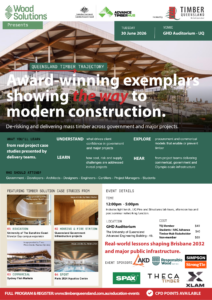 “Queensland Timber Trajectory – Award-winning exemplars showing the way to modern construction” is a forum hosted by WoodSolutions, Timber Queensland and the ARC Advance Timber Hub. Held on Tuesday, 30th June 2026 at The University of Queensland, Advanced Engineering Building, St Lucia Campus.
Registration is through Timber Queensland with ARC Advance Timber Hub Stakeholders and Students able to attend at Timber Queensland membership prices.
The forum is case‑study driven, with each case study focused on real decisions made in practice: why timber was pursued, what almost stopped it, and how commercial, technical and risk barriers were addressed to enable delivery.
The forum has intentionally been positioned beyond general education or advocacy. Timber capability is relatively well understood among design and construction professionals. What remains less resolved are the issues that sit with senior decision‑makers: client confidence, procurement and commercial models, cost certainty, supply capacity, risk allocation and demonstrated delivery experience.