
06
Oct
PROJECT UPDATE: Smarter Robots for Timber Building Assembly
The ARC Advance Timber Hub Project “Autonomous Screw-Fixing Robots for CLT Panel Building Assembly” research team, led by Professor Dikai Liu from the University of Technology, Sydney, has successfully advanced robotic technologies for timber building construction through the development and validation of a mobile robotic system designed to assist with structural screw installation in cross-laminated timber (CLT) panel assemblies. Screw fixing is a critical, repetitive, and labour-intensive task in mass timber construction, and this project has focused on delivering practical, site-ready robotic solutions that enhance productivity, safety, and workforce capability, while integrating seamlessly with existing construction workflows.
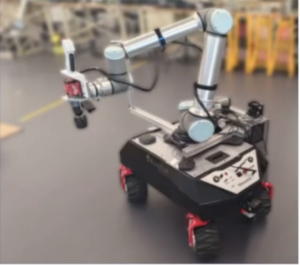
Over the course of the project, the research team designed, developed and tested a significantly improved mobile robotic platform featuring advanced perception, localisation and control capabilities. The latest prototype incorporates a redesigned screw-handling end-effector and gripper, integrated vision and sensing systems, and a mobile base capable of navigating construction environments. The system supports both fully autonomous operation and human-robot collaborative modes, providing flexibility for a range of site conditions and construction workflows.
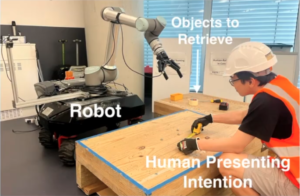
In fully autonomous mode, the robot can navigate a site, identify screw locations using digital building models, and independently undertake screw installation. In human-assisted mode, workers can guide the robot using intuitive inputs such as pointing, laser pointers, or verbal instructions, allowing efficient operation in complex or constrained environments where full autonomy may not be practical.
Professor Liu explained, “A key achievement of the project has been the development of robust machine learning and artificial intelligence algorithms that significantly reduce setup and training requirements. The system can learn from a limited number of demonstrations and reliably identify screws and construction features regardless of orientation, enabling deployment by construction personnel without specialist robotics or programming expertise. Advanced AI capabilities have also enabled natural human-robot collaboration, allowing the robot to observe worker activities and anticipate required tools or materials, supporting more seamless teamwork on site.”
Key Outcomes
 The project delivered:
- Development of robust perception and localisation algorithms for identifying screw locations and construction features in unstructured timber construction environments.
- Development of assisted, guided and autonomous screw installation capabilities for a mobile robotic platform.
- Design of new end-effectors for screw handling.
- Integration of advanced vision systems, custom screw-handling end-effectors and operator-assistance interfaces.
- Development and validation of machine learning approaches for robotic manipulation and human-robot collaboration.
- Robotic system integration and development.
- Evaluation of robotic construction workflows with industry partners to assess practicality, safety and deployment readiness.
- Publication and dissemination of research outcomes through peer-reviewed publications, demonstrations and industry engagement activities.
Industry Engagement and Demonstration
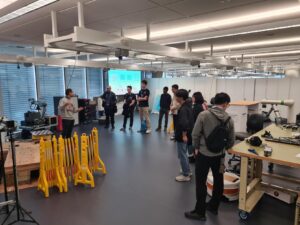
The project team has actively demonstrated the technology, robustness and usability of the system to industry partners, government representatives, international visitors and media outlets.
- The Hon Julian Hill MP Assistant Minister
- BMW Representative Volker Richter
- U.S. Consul General
- Safework Australia
- Visitors from the National Cheng Kung University (NCKU), UTS Workshop
- Tatsuya Manabe and Kohichi Matsui of Ken Robotech Japan
- Journalists from South Korea
- The 22nd Robotics: Science and Systems (RSS) Conference
Importantly, the technologies developed through the project are adaptable beyond screw installation and have potential applications in related construction tasks such as drilling, fastening, material handling and tool delivery.
 This project has generated significant new knowledge in construction robotics, intelligent automation and human-robot collaboration for timber construction. By automating physically demanding and repetitive tasks, the technology has the potential to improve productivity, enhance workplace safety and reduce physical strain on construction workers.
The project demonstrates how targeted, task-specific robotics can deliver practical value to the timber construction sector by prioritising usability, flexibility and collaboration with workers. The outcomes strengthen Australia’s research capability in advanced robotics, artificial intelligence and digital construction technologies, positioning the sector to benefit from future innovations in automated and collaborative construction systems.
Learn More
To learn more, please visit the project page:“Autonomous Screw-Fixing Robots for CLT Panel Building Assembly” and view project videos below.
This project directly supports the ARC Advance Timber Hub’s Manufacturing Innovation Research Node by introducing robotics and automation into timber construction processes. By enabling precise, efficient and scalable installation of prefabricated timber systems, the project improves productivity and accelerates the adoption of advanced manufacturing approaches in Australia’s construction sector.