
02
Jul
PROJECT UPDATE: Understanding Fire Behaviour in Open-Plan Timber Ceilings
Through its project Performance of Building Components – Fire Safety Design of Open Plan Timber Compartments, the ARC Advance Timber Hub is addressing a critical knowledge gap in the fire safety design of modern mass‑timber buildings: how exposed timber ceilings behave in large, open‑plan compartments such as offices and commercial buildings. These spaces are increasingly common, yet current fire design guidance is largely based on testing of timber in floor‑like (face‑up) orientations, not ceilings.
The project, led by Associate Professor David Lange and incorporating the research work of PhD candidate Josh Madden, from The University of Queensland School of Civil Engineering, brings together researchers and industry partners to generate new, design‑relevant evidence to support safe, performance‑based fire engineering solutions for timber buildings. Associate Professor Lange presented to ARC Advance Timber Hub Stakeholders a project update via a webinar series on the 26th May 2026.
Project Design
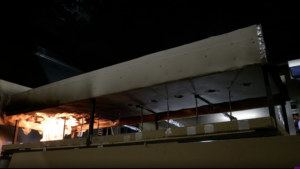
The project focuses on a key gap in fire design guidance, which is in understanding how timber ceilings ignite and how flames spread once ignition occurs in large spaces, without significant internal separation, such as offices and commercial buildings. The project is designed to provide the experimental evidence needed to reduce the uncertainty of how timber behaves through a unique multi‑scale experimental program with three key test areas:
- Bench‑scale testing
Small‑scale laboratory tests are being used to study:
- Ignition delay and critical heat flux of timber in both face‑up and ceiling (inverted) orientations.
- The influence of gas flow velocity, representative of ceiling jets, on ignition and flame spread.
- Intermediate‑scale compartment testing
The research then scales up to a one‑eighth scale compartment, allowing rapid testing of many variables under controlled conditions. These tests examine:
- Fire size and flame impingement on ceilings
- Ventilation and ceiling jet velocities
- The influence of ceiling obstructions (e.g. beams)
- Different fuel types and fire scenarios
A controlled gas burner is used to generate repeatable fire plumes, with detailed instrumentation measuring temperatures, gas velocities and heat fluxes beneath the ceiling.
- Full‑scale fire testing
Full‑scale compartment tests are being prepared at the Queensland Fire Department (QFD) live fire and heavy rescue training facility at the Queensland Combined Emergency Services Academy (QCESA), located on Whyte Island at the Port of Brisbane. These tests focus on fire dynamics rather than structural performance, using full‑size CLT ceiling panels to confirm that the mechanisms observed at smaller scales remain valid in realistic building conditions.
A total of 32 CLT slabs donated by Next Timber are being heavily instrumented with thermocouples and heat‑flux sensors. The full‑scale program is designed to validate the experimental framework and provide confidence for real‑world application.
Key findings to date
Results emerging from the project demonstrate that:
- Orientation matters: Timber ceilings behave differently from timber floors. Critical heat flux for ignition is similar for both orientations; however ignition occurs later and more variably when timber is installed as a ceiling.
- Ventilation and ceiling jet velocity are critical: Flowing hot gases significantly increase flame attachment and flame spread along ceilings.
- Multi‑scale consistency is achievable: The same governing fire dynamics can be observed from bench scale through to full scale when experiments are carefully designed.
Industry engagement and outcomes
This project has strong and ongoing industry involvement, with partners contributing to experimental design, interpretation of results and application to practice. Key outcomes to date include:
- Peer‑reviewed journal papers accepted in Fire Safety Journal on timber ceiling ignition and fire safety strategy.
- ORIENTATION EFFECTS ON THE IGNITION OF MASS TIMBER CEILINGS: A BENCH-SCALE INVESTIGATION
- THE FIRE SAFETY STRATEGY
- Conference presentations in Australia and internationally:
- IGNITION OF A TIMBER CEILING: ANALYSING CONVECTIVE AND RADIATIVE HEATING EFFECTS
- COUPLING FIRE AND MASS TIMBER STRUCTURES: A CHALLENGE FIRE SAFETY DESIGNERS MUST ADDRESS
- BURNING BEHAVIOUR OF A TIMBER CEILING: A BENCH-SCALE INVESTIGATION
- A METHOD TO STUDY IGNITION OF INVERTED COMBUSTIBLE SURFACES
- RETHINKING FIRE SAFETY FOR TIMBER BUILDINGS: IGNITION, SPREAD, AND PERFORMANCE-BASED DESIGN
- Regular project meetings that keep industry partners closely engaged as results emerge.
The project team is continuing testing through 2026, with design‑focused guidance and publications expected as results are consolidated.
Learn More
For further information or to follow project progress, visit the project page:
Fire Safety Design of Open Plan Timber Compartments – ARC Advance Timber Hub
https://www.advance-timber-hub.org/project/fire-safety-design-of-open-plan-timber-compartments/