
15
May
PROJECT UPDATE: Industry Led Research Advancing Long Span Timber Floor Performance
The ARC Advance Timber Hub is delivering new insights to support the confident use of long span timber and hybrid floor systems in commercial and multi storey buildings.
Through its project Innovative Long Span Timber and Wood Based Hybrid Floors for Vibration Performance and Acoustic Compliance, the Hub is addressing one of the key challenges facing modern timber construction: ensuring floors are comfortable for occupants while meeting vibration and acoustic requirements, particularly as spans increase and structures become lighter.
Professor Hassan Karampour – Griffith University, alongside project PhD Candidate Adam Faircloth, convened a highly engaging and collaborative project team workshop at Northrop Consulting Engineers in Sydney on the 13th of May 2026 to share findings from an integrated program of laboratory testing, field measurements, occupant perception studies and industry engagement.
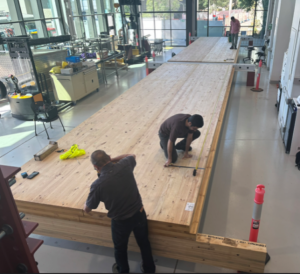 Key progress to date includes:
- Testing of multiple long span timber and hybrid floor systems, including CLT, timber–concrete composite, timber–steel hybrids and lightweight joisted systems
- Measurement of vibration and acoustic performance at different construction stages, from bare structure to fully fitted out and occupied buildings
- Direct comparison of engineering metrics and human perception of vibration, informing future assessment approaches
- Identification of practical, low risk design and retrofit strategies to improve floor performance without increasing structural mass
Key technical insights emerging
- Real world building performance is critical
Field testing has demonstrated that:
- Floor vibration performance often improves substantially after fit out, furniture and occupancy are introduced
- Laboratory only assessments can over predict vibration issues if real building conditions are not considered
- Performance evolves over the building lifecycle, highlighting the importance of testing at multiple stages
- Human comfort does not always align with traditional checks
Studies conducted as part of the project show that vibration measures accounting for duration and cumulative exposure correlate more strongly with occupant feedback. A central finding of the project is the mismatch between:
- Conventional vibration limits based on peak acceleration, and
- How occupants perceive comfort and annoyance
- Effective performance improvements do not require heavier floors
The project provides strong evidence that vibration and acoustic performance can be significantly improved through targeted, practical interventions, including:
- Improved connections
- Access floors and floating floor systems
- Targeted damping solutions
- Vibration and acoustics must be addressed together
The project has confirmed that vibration and acoustic performance in timber floors are inherently linked, particularly in long span and lightweight systems where low frequency behaviour governs both occupant comfort and sound transmission. Footfall induced vibration not only affects perceived floor stiffness and comfort but can also generate structure borne noise, contributing to acoustic non-compliance if not adequately addressed.
Importantly, this project is being delivered in close alignment with the ARC Advance Timber Hub project “Influence of CLT Manufacturing Variables on Vibration and Acoustic Performance,” which investigates how CLT properties and manufacturing parameters affect vibration, acoustics and damping.
Industry relevance and impact
The findings are contributing to the development of evidence-based design guidance and tools that will support engineers, architects and builders in optimising timber floor systems, reducing risk and increasing confidence in long span timber applications.
The outcomes are particularly relevant to commercial offices, education buildings, residential developments and public infrastructure, where occupant comfort and acoustic performance are critical.
Next steps
Over the next phase, the project will focus on:
- Additional testing of completed and occupied buildings
- Refinement of vibration and acoustic prediction models
- Development of clear, practitioner focused design guidance
- Contribution to future Australian standards, guidelines and best practice documents
Article Promotion
This article has been referenced in the Timber & Forestry ENews 900th Edition on page 11 – New long-span floor research