
25
May
PROJECT UPDATE: Hub Research Managing Moisture During Construction and Early Life Stages
The ARC Advance Timber Hub Project “Role of Moisture in the Long-Term Performance of Mass Timber Building Elements” is addressing the issue of how moisture affects the durability, mould risk and long‑term performance of timber building elements under Australian conditions.
This project is supported by PhD Candidate, Paulo Silvares, at the University of the Sunshine Coast, whose research is focused on “Integrated Assessment of Hygroscopic Behaviour and Mould Growth in Construction Timber”, under the supervision of Project Leader – Professor Tripti Singh and Project Chief Investigator – Dr Zidi Yan. Paulo updated ARC Advance Timber Hub Stakeholders on the research via a webinar presentation on the 19th May 2026.
Why this research matters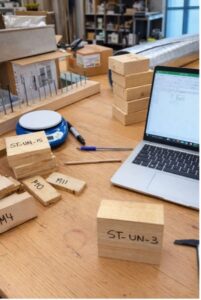
Timber products such as Cross Laminated Timber (CLT), Glue Laminated Timber (GLT/Glulam) and solid timber elements are often exposed to rain, humidity and temperature fluctuations during transport, storage and construction. Even temporary exposure can result in:
- Cracking, warping and dimensional instability
- Increased risk of surface mould growth
- Aesthetic, health and indoor environment concerns
- Costly delays, remediation and reputational impacts
These risks are particularly significant in Australian climatic conditions, which are highly favourable for fungal growth.
Project focus and approach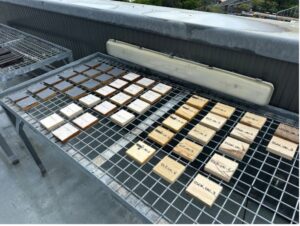
Project focus is on the understanding of how moisture enters, moves through and remains within timber systems, particularly during the construction and storage phase. The research combines:
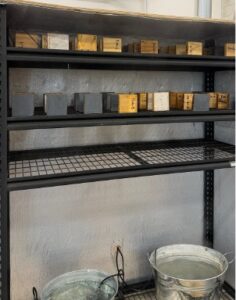
- Laboratory testing of moisture uptake, drying behaviour and dimensional stability
- Accelerated moisture cycling experiments to assess durability and damage mechanisms
- Evaluation of protective systems, including membranes, tapes and coatings
- Outdoor exposure trials to compare laboratory results with real environmental conditions
- In‑situ monitoring, using sensor data from buildings such as the University of the Sunshine Coast Moreton Bay Campus
A key objective is to provide industry with best practice guidelines for moisture management during construction and post-construction.
 Key insights to date
- No single “safe exposure time” exists
Timber performance is strongly influenced by humidity, temperature and ventilation. Time‑based assumptions alone are not reliable predictors of mould risk. - Protective membranes reduce risk but are not fail‑safe
Damage during handling and installation, partial coverage and limited breathability can allow moisture to enter and become trapped within timber elements. - Timber species drying behaviour can differ
Radiata pine has shown variable drying behaviour, compared with eucalyptus. - Standard test methods adaptation needed
Existing accelerated ageing methods were not designed for modern membrane‑protected timber systems. Adaptation is required to better reflect realistic construction exposure while still providing meaningful comparative data.
Next steps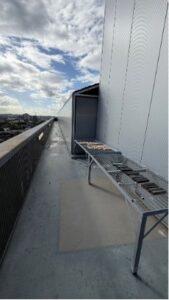
The project is now moving from exploratory testing into more refined experimental and predictive stages, including:
- Ongoing outdoor exposure trials and data comparison
- Further testing of commercially supplied timber and protection systems
- Detailed analysis of drying behaviour, shrinkage and moisture retention
- Development of predictive frameworks to support decision‑making in construction
Industry impact
Ultimately, the project aims to deliver practical, evidence‑based guidance that will help industry:
- significantly enhance the resilience and longevity of timber buildings by addressing the critical issue of moisture intrusion
- understand moisture ingress pathways and implications
- adopt proactive measures for moisture exclusion and management.