New Research Looks to Underutilised Timber to Address Australia’s Housing Challenge

New AFWI‑funded research led by The University of Queensland will develop bio‑based construction systems to deliver low‑cost, prefabricated housing and strengthen Australia’s forestry and manufacturing supply chains.

As Australia faces mounting housing affordability and supply pressures, ARC Advance Timber Hub Chief Investigator, Associate Professor Joe Gattas from the University of Queensland’s School of Civil Engineering is leading a new four‑year national research project exploring how underutilised timber resources could help deliver more affordable, sustainable housing solutions.

This research project is funded by the Australian Forest and Wood Innovations (AFWI) Centre for Sustainable Futures (University of the Sunshine Coast). It aims to unlock new value from Australia’s wood fibre while supporting the delivery of low‑cost, prefabricated buildings. Titled Bio-based Construction Systems for Small-Footprint Dwellings and Multifunctional Outbuildings. 

This project builds on earlier bio-based housing research (see ARC Advance Timber Hub Research Node: Value-Chain Innovation & News: ARC Advance Timber Hub Investigators Pioneer Disaster-Proof Timber-Cardboard Housing, Tackling Climate Crisis, and Reducing Bio Waste in NSW) and will develop innovative construction systems for tiny homes, secondary dwellings, and multifunctional outbuildings.
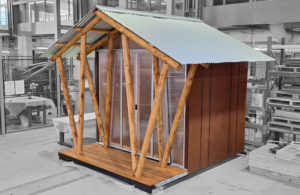
“By rethinking how we use Australia’s existing timber and wood by-products, this project aims to demonstrate that affordable housing solutions can be delivered using locally sourced, low‑embodied‑carbon materials,” Associate Professor Gattas said. “Our focus is on practical, adaptable construction systems that maximise value from underutilised resources, support regional supply chains, and respond to the rapidly growing demand for small-footprint and prefabricated buildings.”

Delivered through a collaboration of university, industry, and government partners, the initiative seeks to strengthen Australia’s sovereign manufacturing capability, support regional economies, and contribute to a more sustainable and affordable future for the built environment.

For more information please see the AFWI Centre for Sustainable Futures (University of the Sunshine Coast) Project Media Release:

New project to transform timber by-products into affordable, sustainable housing solutions

Wood Central Article:

Turning Thinning’s into Buildings — Australia’s Fix for Tiny Homes


Research Lead: Associate Professor Joe Gattas – University of Queensland’s School of Civil Engineering

Research partners:
Bond University (Kim Baber), Southern Cross University Andrew Rose), and Queensland Government Department of Primary Industries (Rob McGavin and Thomas Davies)

University of Queensland (UQ) collaborators: UQ School of Civil Engineering (Liam Ottenhaus), UQ School of Architecture, Design and Planning (Mehrnoosh Mirzaei), and UQ School of Electrical Engineering and Computer Science (Dhaval Vyas).

Industry and government partners: Hurford Group, Weathertex, AKD, NSW Government Department of Primary Industries and Regional Development, Jowat Adhesives, Container of Dreams, ADG Engineers, Structural Panels Australia (SPA) and Ausco Modular.
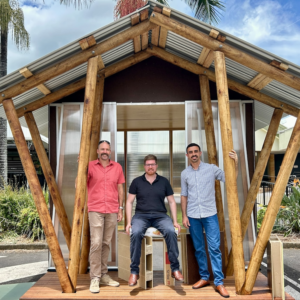
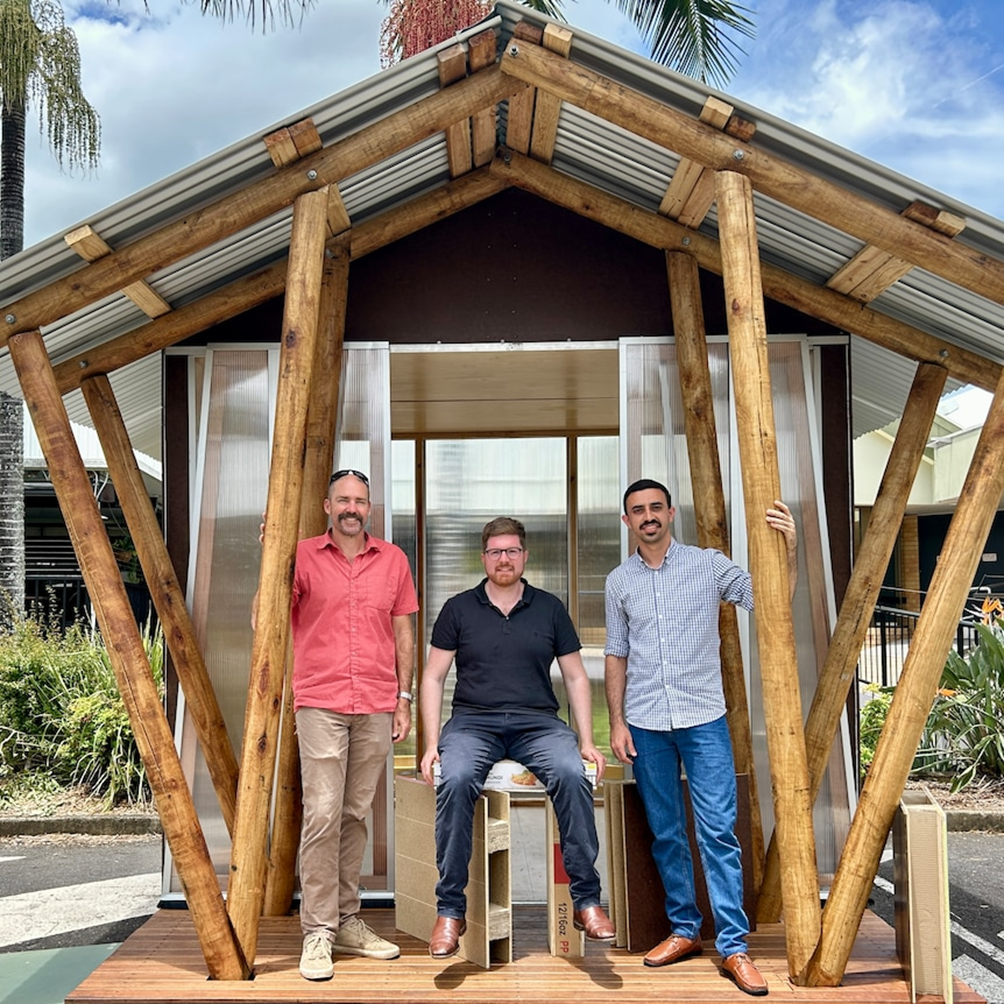
Photo: (L-R) Prof. Andrew Rose (Southern Cross University), A/Prof Joe Gatass (UQ Civil Engineering), and PhD Candidate Mahmoud Abu-Saleem  (UQ Civil Engineering) at Lismore prototype exhibition.
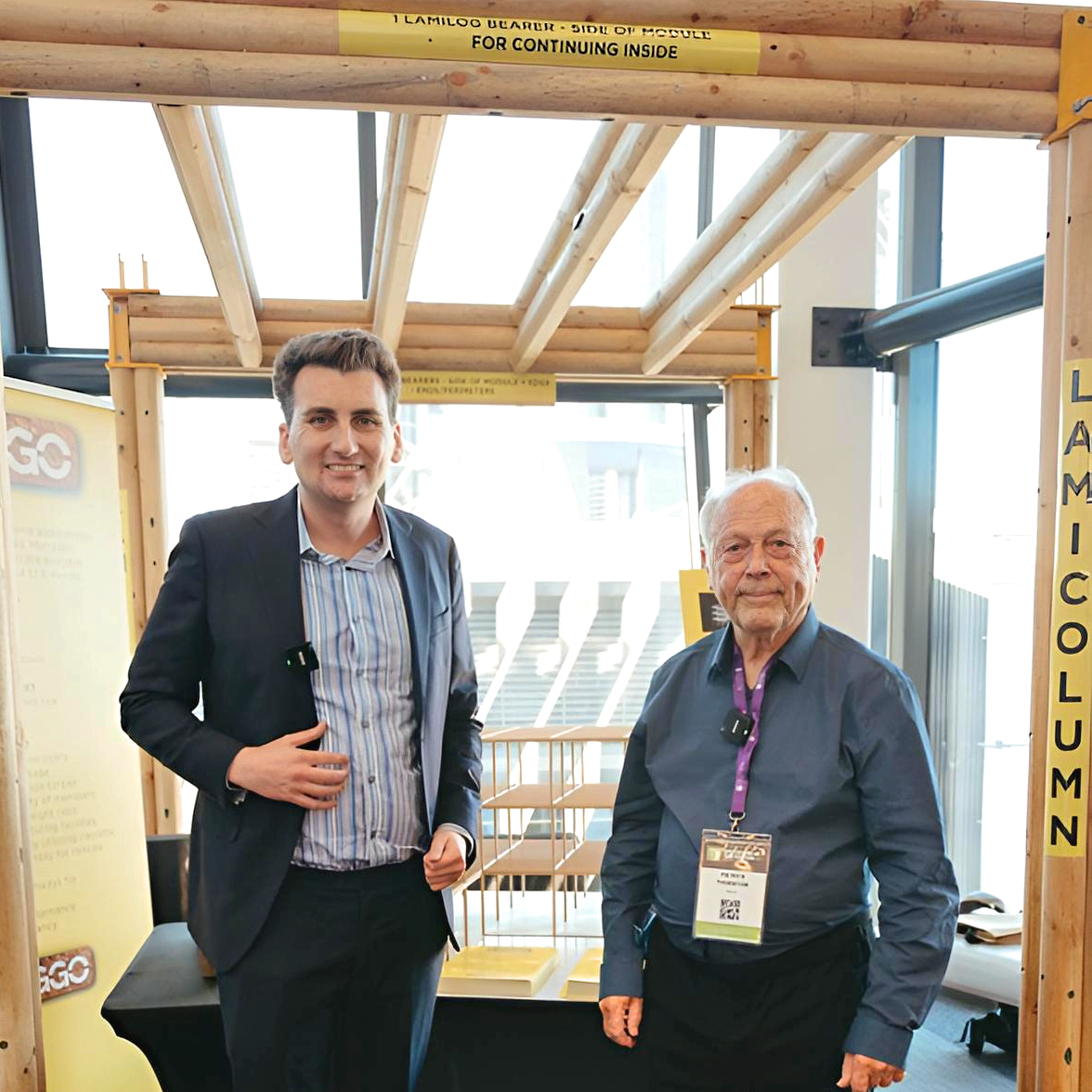
Small-Log Framing Concept showcased by Hub Partner Loggo

The ARC Advance Timber Hub is pleased to share a recent Wood Central article highlighting the work of ARC Advance Timber Hub partner, Loggo.

The article “Loggo’s System Heads to the USA — Built for What CLT Can’t Reach!”   showcases that Loggo’s low-cost engineered wood system built from peeler cores and forest thinnings will make its international debut at the International Mass Timber Conference in Portland, Oregon, this month.

This work aligns with ARC Advance Timber Hub Project “Establishing Viable Product and Market Solutions for Hardwood Plantation Thinnings and Small Logs”.

To learn more about Loggo’s exciting work, we encourage you to read the full article on Wood Central, along with watching the video below filmed at the World Conference on Timber Engineering 2025.

Timber Framing Carbon Calculator

WoodSolutions has released the Timber Framing Carbon Calculator, a free online tool that enables residential builders to demonstrate the carbon stored in the timber-framed homes they construct. Source: Timberbiz

As Australia’s leading source of independent information on designing and building with timber, WoodSolutions provides trusted, non‑proprietary resources to industry. Developed by Forest & Wood Products Australia (FWPA), a partner of the ARC Advance Timber Hub, WoodSolutions supports architects, designers, engineers, builders, developers, and educators to increase confidence in timber use across the built environment.

Builders can access the Carbon Calculator and download their Carbon Certificate at
https://www.woodsolutions.com.au/carbon-calculator

View article by Timberbiz:

Timber framing carbon calculator

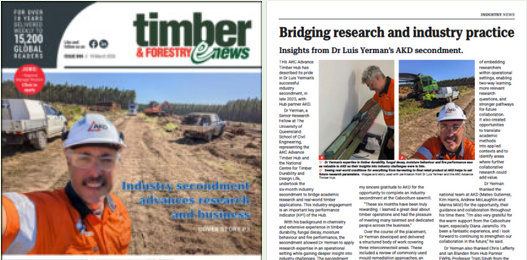
Bridging Research and Industry Practice: Insights from Dr Luis Yerman’s AKD Secondment

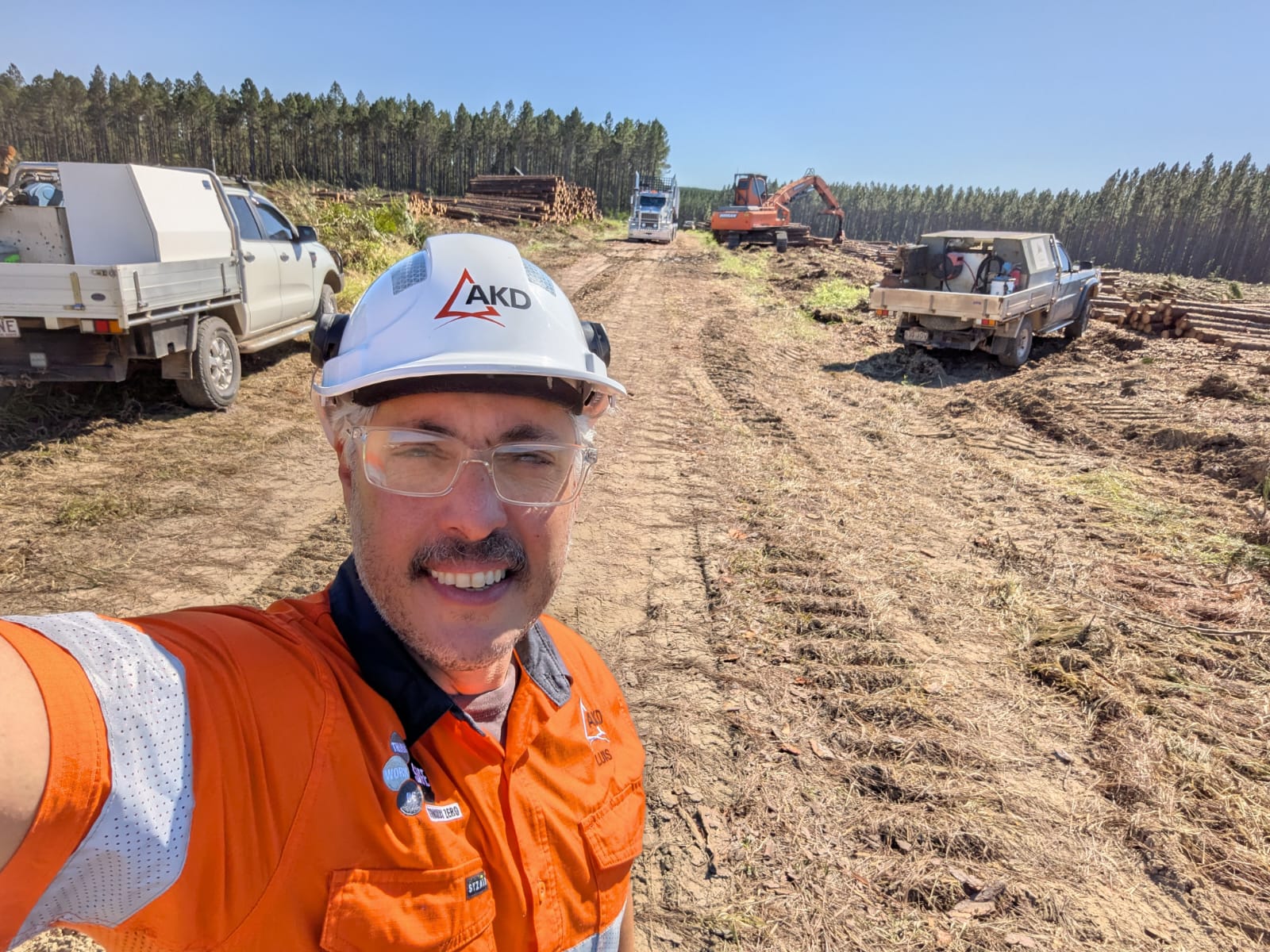
The ARC Advance Timber Hub is proud of Dr Luis Yerman’s successful industry secondment, in late 2025, with Hub partner, AKD. Luis, a Senior Research Fellow at The University of Queensland School of Civil Engineering, representing the ARC Advance Timber Hub and the National Centre for Timber Durability and Design Life, undertook the six-month industry secondment to bridge academic research and real-world timber applications. This industry engagement is an important key performance indicator (KPI) of the Hub.

With a background in chemistry and extensive experience in timber durability, fungal decay, moisture behaviour, and fire performance, the secondment allowed Luis to apply research expertise in an operational setting while gaining deeper insight into industry challenges. The secondment was designed to explore the broader issue of mould in timber products, from its underlying causes through to management and prevention across the product lifecycle.

Luis stated, “I’d like to express my sincere gratitude to AKD for the opportunity to complete an industry secondment at the Caboolture sawmill. These six months have been truly rewarding. I learned a great deal about timber operations and had the pleasure of meeting many talented and dedicated people across the business.”

Over the course of the placement, Luis developed and delivered a structured body of work covering three interconnected areas. These included a review of commonly used mould remediation approaches, an investigation of material characteristics that influence moisture and biological behaviour, and an assessment of environmental conditions relevant to timber storage and handling. Together, these activities provided a holistic framework for understanding mould risk from multiple angles.

A key objective of the secondment was knowledge exchange. By working at the interface between research and industry practice, the project supported clearer alignment between scientific understanding and practical decision-making. It demonstrated the benefits of embedding researchers within operational settings, enabling two-way learning, more relevant research questions, and stronger pathways for future collaboration. It also created opportunities to translate academic methods into applied contexts and to identify areas where further collaborative research could add value.

Luis thanked the national team at AKD (Mateo Gutierrez, Kim Harris, Andrew McLaughlin and Marina Milić) for the opportunity, their guidance and collaboration throughout his time there, “I’m also very grateful for the warm support from the Caboolture team, especially Diana Jaramillo. It’s been a fantastic experience, and I look forward to continuing to strengthen our collaboration in the future.”

Luis also thanked Chris Lafferty and Ian Blanden from Hub Partner, FWPA; Professor Tripti Singh from the National Centre for Timber Durability and Design Life, and Hub Director, Professor Keith Crews, for their support and engagement throughout his journey.

Luis’s secondment shows how industry–research partnerships address real-world challenges and lays the groundwork for ongoing collaboration between academia and the timber sector.

Building with Timber: Construction, Performance & Design Life

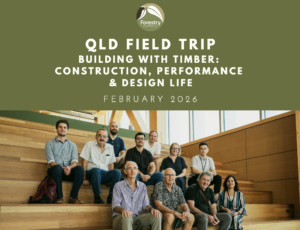
The Forestry Australia Queensland Branch organised a field day in Moreton Bay on the 12th February 2026, where they showcased the timber construction of the University of the Sunshine Coast (UniSC) Moreton Bay campus; performance research by the National Centre for Timber Durability and Design Life; and durability treatment at the ITreat Timber in Narangba.   The day delivered high-quality technical engagement across design, research and industry practice.

This event was attended by ARC Advance Timber Hub stakeholders: Kelly Rischmiller (Manager), Tom Wright (Research Fellow on Project: Connection Systems for Extended Building Life), Pietro Rigo (visiting PhD student), Zidi Yan (Chief Investigator) and Prof Tripti Singh, who presented on the Durability Centre and also referenced Hub Project: Role of Moisture in the Long-Term Performance of Mass Timber Building Elements. where sensors for this project are located throughout the campus.

To view the full report, including photos, from Forestry Australia Queensland Branch click here.

University of the Sunshine Coast – Moreton Bay Campus – Key Takeaways from visit:

Project Team
Three new buildings constructed by BADGE Construction and designed by KIRK Studio in collaboration with Cottee Parker.

Project Consultant and Construction Team:
WILD Studio, Landscape Consultant

Aurecon, Civil, Traffic, Electrical, Dry Fire, Environmental & Sustainability, Acoustic, Facade, Audio Visual Engineer
WSP, Mechanical, Hydraulic, Fire, Vertical Transport Engineer
Certis, Building Certification, Section J & Access
Omnii, Fire Engineer
Cottee Parker, Construction Documentation & Delivery Architect

Design Approach

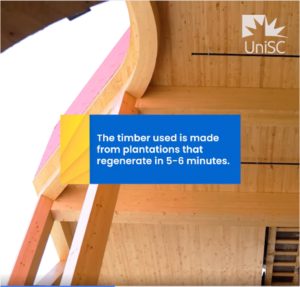
The Mass Engineered Timber for all three buildings were supplied by combining HESS Timber’s PEFC-certified glulam (imported) and Xlam’s PEFC-certified cross-laminated timber (Australian).

The precision and early procurement required for these materials demanded highly detailed structural and building services coordination from the outset, ensuring accuracy, integration, and constructability.

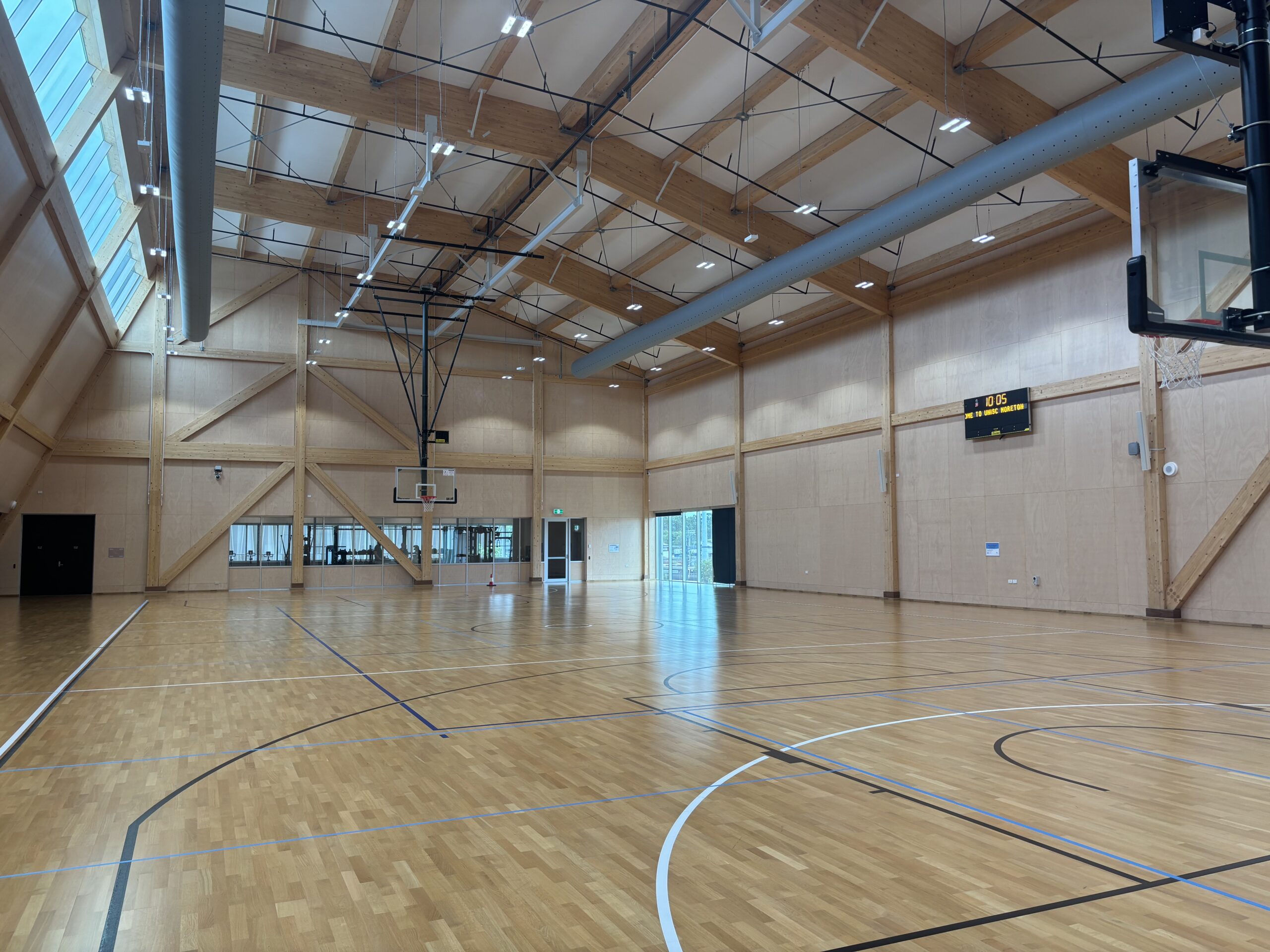
Australian araucaria™ was used extensively throughout offices, corridors, teaching spaces, student hubs, and internal sports court cladding.

Its architectural and acoustic qualities contributed to a contemporary, warm, and highly functional interior environment.

All araucaria™ components were manufactured and prefinished by Austral Plywoods, supporting efficiency and quality.

Environmental and Construction Benefits

According to Richard Kirk, Principal of KIRK Studio, the combined use of prefabrication and mass timber:

“has proven to sequester carbon using renewable timber feedstock to significantly reduce construction time, reduce waste, and support safer and quieter construction sites.”

Josh Patrick, Project Manager at BADGE Constructions, observed:

“The architectural qualities of australian araucaria™ made it a great choice for the project. The light colour gave the open plan spaces a light feeling. It looks good and is locally sourced which was a huge plus for our team.”

Delivery and Construction Methodology

A tight project timeline required the design and construction teams to adopt off‑site factory fabrication and modular assembly methods.

The modular timber approach enabled rapid installation, reduced onsite time, and maintained a high-quality, sustainable finish.

https://www.facebook.com/unisunshinecoast/videos/202032045979754/


Sources:
https://www.cotteeparker.com.au/newsroom/university-of-the-sunshine-coast-moreton-bay-stage-2/

Top timber engineers take time to tour during world conference

Sunshine Coast’s $100m Timber Rich Campus Tackles Inequality

The University of the Sunshine Coast